
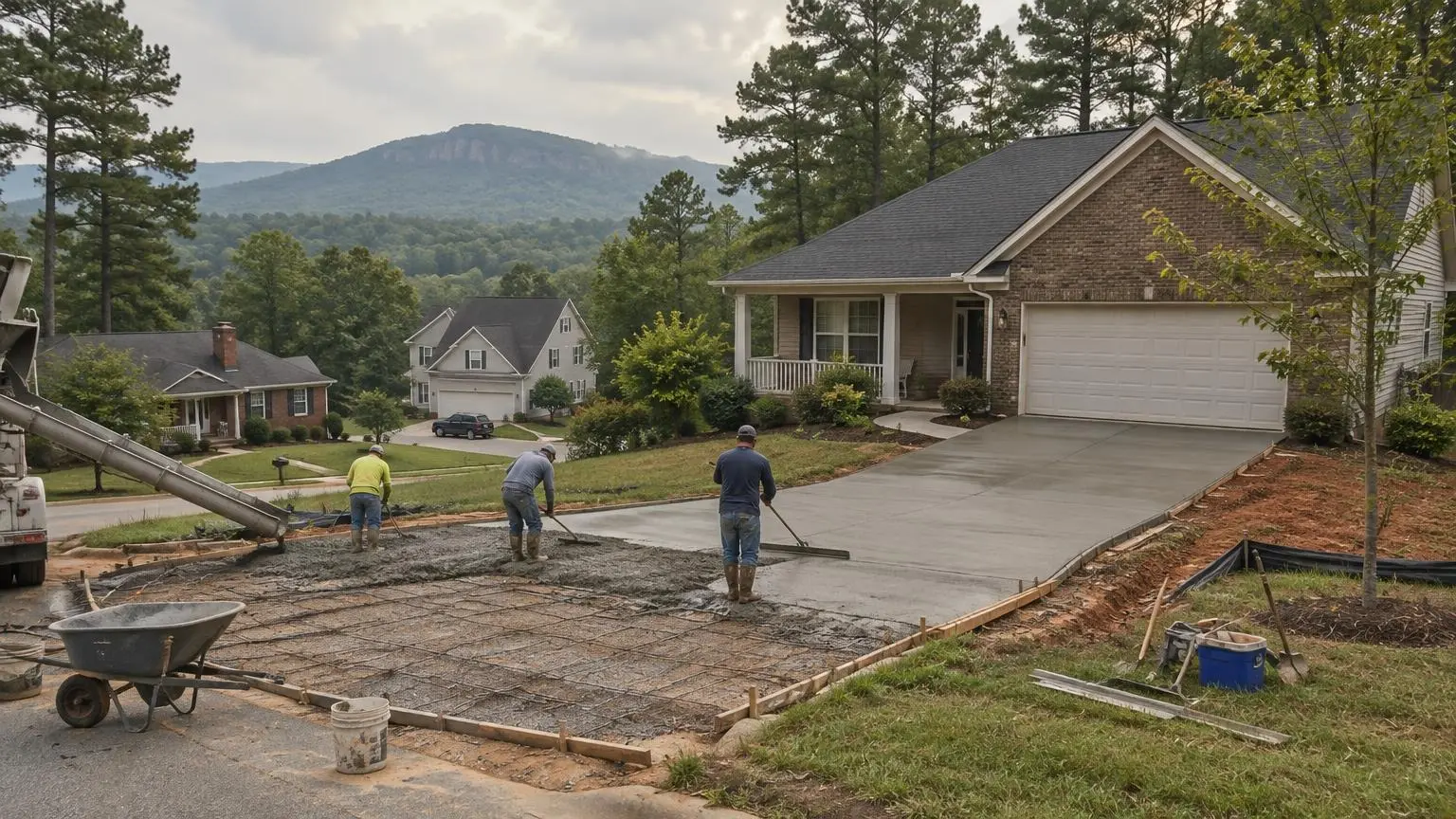
Cracks, sunken slabs and worn surfaces
Concrete Repair in Gastonia, NC
We fix what can be fixed and tell you straight when a slab has failed underneath.
- Estimates are free and done on site, with slope and drainage checked
- Every price comes in writing, line by line
- Street-side driveway work checked against City of Gastonia apron rules
Repair or Replace? Start With the Cause
Concrete repair pays off when the slab is still well supported and the trouble is at the surface or at a joint. It is money wasted when the base has washed out or the soil has shifted, because the damage returns. With about half of Gastonia's homes built before 1980, according to census survey data, much of the concrete in town is decades old, and every repair visit starts by working out which of those two cases we are looking at.
Problems we look for
- Cracking: from shrinkage, settling, roots or heavy loads
- Sunken panels: slabs that dropped as the soil or stone beneath them washed away or compressed
- Lips at joints: one panel raised or dropped against the next
- Scaling and spalling: flaking, pitting or chipped surfaces where water froze in weak concrete
- Leaning steps: porch or garage steps tipping or pulling away
- Washed-out edges: soil eroded from under the slab edge by runoff
Why concrete breaks down here
Red clay under a slab soaks up water after storms and shrinks when it dries, and that movement opens cracks and lets panels settle. Gastonia gets close to 44 inches of rain a year, and runoff from a gutter or the street can wash away the base along an edge. In winter, average January lows near 31 degrees mean water trapped in a crack can freeze and expand overnight. Stopping the water, whether that means redirecting a downspout, filling a low spot or resealing a joint, is part of almost every repair that lasts.
How we fix it
- Rout and seal: cracks opened up, cleaned and filled with flexible sealant
- Lifting: sunken slabs raised by pumping cement grout (mudjacking) or expanding polyurethane foam (polyjacking) beneath them
- Resurfacing: a thin bonded topping that renews worn or scaled concrete that is still sound
- Joint work: failed joint filler pulled out and replaced to keep water out
- Section replacement: one or two bad panels sawn out and repoured while the rest stays
- Step rebuilds: settled or broken steps torn out and reformed
When new concrete wins
HomeGuide's resurfacing guide recommends repair or resurfacing for light flaking and cracks narrower than a quarter inch, and replacement for wider cracks, crumbling, deep spalling or structural problems. It adds that cracks over a quarter inch can signal foundation movement worth a structural engineer's look. If we spot that, you hear about it before paying for surface work. Lifting has limits too: a slab broken into many pieces may not rise as one, and replacing it is the better buy.
Making a repair last
- Turn downspouts and sump discharge away from the concrete
- Keep joints and cracks sealed against water
- Reseal the surface every few years, particularly on older slabs
- Call early at the first sign of new settling, while lifting is still possible
Phasing work on older homes
On a lot of older Gastonia homes, the drive, walk and steps went in at different times. We can repair one piece now and plan the others in stages, so you are not stuck replacing everything at once.
Repair Work We Do
Fixes for the concrete you already own, indoors and out.
Crack sealing
Cracks cleaned, routed where needed and filled with flexible sealant.
Slab lifting
Sunken drive, walk, patio and garage slabs raised with grout or foam.
Resurfacing
A bonded topping that renews scaled, pitted or stained concrete on a sound slab.
Step and landing fixes
Chipped nosings patched, or settled steps rebuilt with matching risers.
Panel replacement
Failed sections sawn out at the joints and repoured on a fresh base.
Joint resealing
Old filler removed and replaced so water stays out of the base.
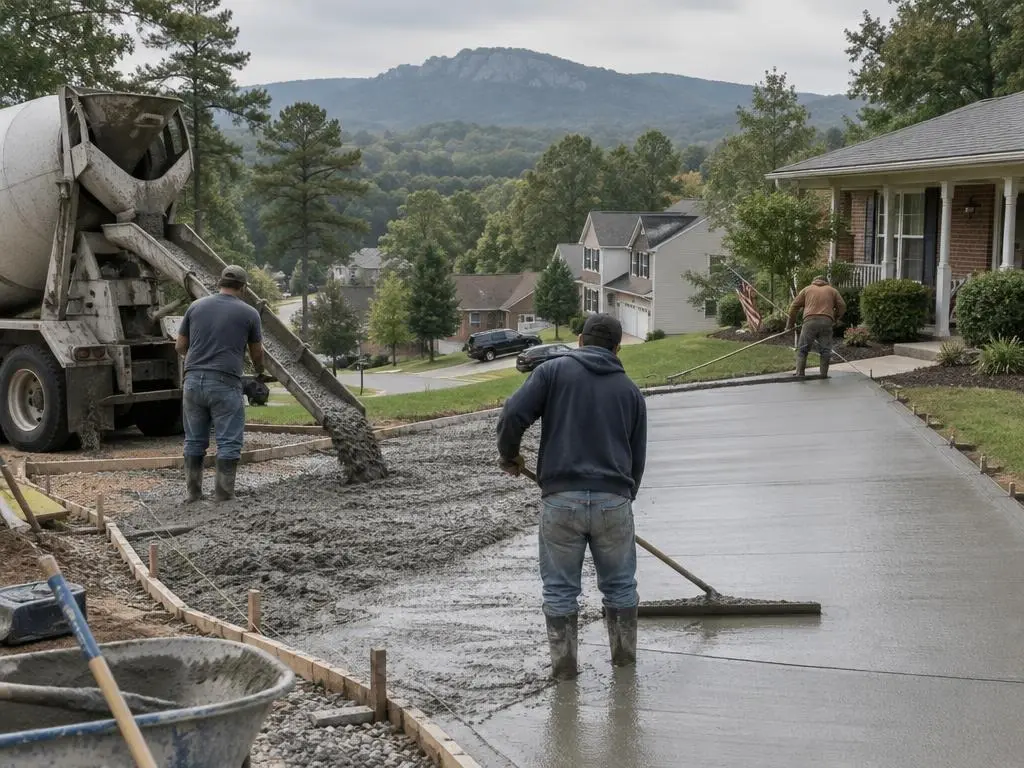
Typical Concrete Repair Costs
| Repair | Published range |
|---|---|
| Crack filling, per linear ft | $0.50 to $3 |
| Small cracks and potholes | $100 to $400 |
| Resurfacing, per sq ft | $3 to $7 |
| Two-car driveway resurfacing | $1,200 to $2,900 |
| Mudjacking, per sq ft | $4 to $9 |
| Polyjacking, per sq ft | $8 to $25 |
| Sidewalk leveling (100 sq ft) | $400 to $900 |
| Steps leveling (40 sq ft) | $300 to $500 |
National ranges from HomeGuide's concrete resurfacing, mudjacking and sidewalk cost guides. Gastonia prices can differ, many repair jobs carry a minimum charge, and the cause of the damage changes the right fix. Your written estimate is the price.
Start to Finish
1. Find the cause
We look at the damage, the base, the drainage and nearby trees.
2. Lay out the options
You get a written price for the repair, plus a frank note if replacement makes more sense.
3. Make the fix
Cracks are sealed, slabs lifted, surfaces resurfaced or panels replaced.
4. Address the water
We point out runoff or drainage problems so the fix holds.
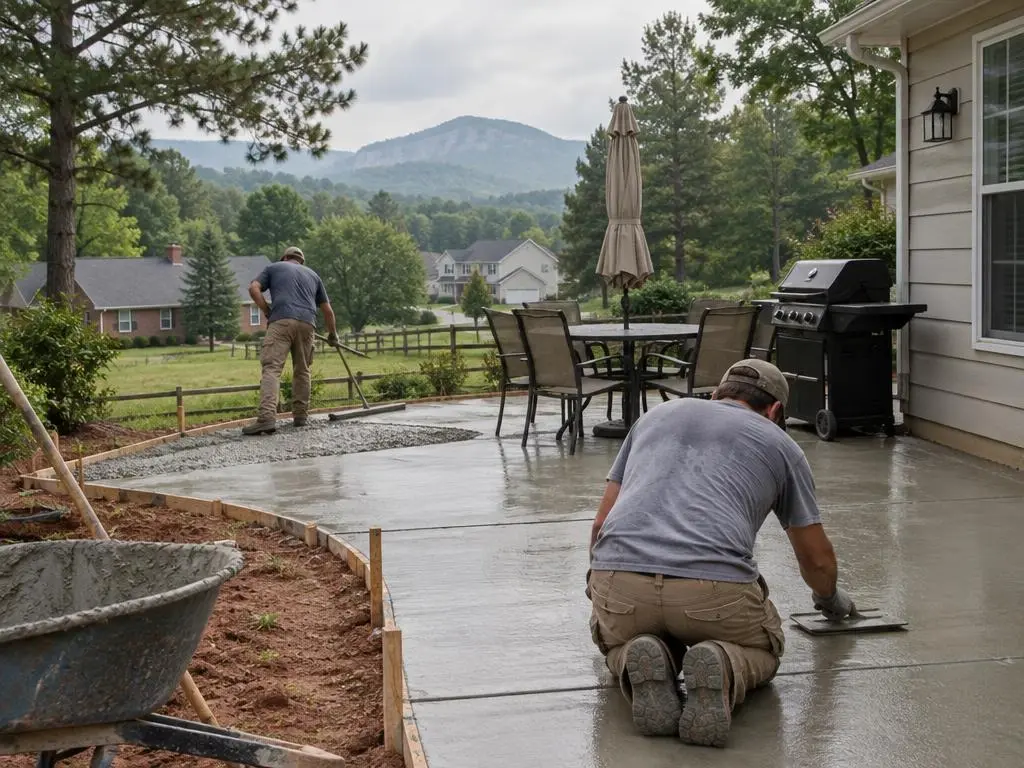
Concrete Repair Questions
Can a sunken driveway be lifted?
Frequently, yes. When the slab is in one or two big pieces, mudjacking or polyjacking can bring it back to level. HomeGuide's mudjacking guide lists $4 to $9 per square foot for mudjacking and $8 to $25 for polyjacking. Slabs broken into many pieces are better replaced.
Grout or foam for lifting?
Mudjacking pumps a cement grout and costs less. Foam weighs much less, needs smaller holes and sets fast. On clay that stays wet, the lighter weight of foam can help. We recommend one once we have seen the slab.
Can resurfacing save a cracked driveway?
Only when the cracks are small and the slab is not moving. A resurfacing layer is thin, so wide cracks and shifting panels show through again. HomeGuide's resurfacing guide says a resurfaced slab lasts about 8 to 15 years on a sound base.
When does a crack mean a foundation problem?
Driveway and walk cracks usually do not. Cracks in a slab floor or foundation wider than about a quarter inch, or cracks that keep growing, can mean structural movement, and a structural engineer should see them before any repair.
Is old concrete worth repairing?
When the slab is level, well supported and only worn or cracked on top, a repair costs far less than new concrete. When it has sunk, broken into pieces or lost its base, a repair will not hold.
Concrete Repair Service Areas
- Concrete Contractors in Gastonia, NC
- Concrete Contractors in Belmont, NC
- Concrete Contractors in Mount Holly, NC
- Concrete Contractors in Cramerton, NC
- Concrete Contractors in Lowell, NC
- Concrete Contractors in McAdenville, NC
- Concrete Contractors in Ranlo, NC
- Concrete Contractors in Dallas, NC
- Concrete Contractors in Stanley, NC
- Concrete Contractors in Bessemer City, NC
- Concrete Contractors in Cherryville, NC
- Concrete Contractors in Kings Mountain, NC
- Concrete Contractors in Lincolnton, NC
- Concrete Contractors in Shelby, NC
- Concrete Contractors in Clover, SC
- Concrete Contractors in Lake Wylie, SC
- Concrete Contractors in Tega Cay, SC
- Concrete Contractors in York, SC
- Concrete Contractors in Fort Mill, SC
- Concrete Contractors in Rock Hill, SC
- Concrete Contractors in Denver, NC
Get a Concrete Repair Estimate
Free repair visits for drives, walks, patios and steps in Gastonia.